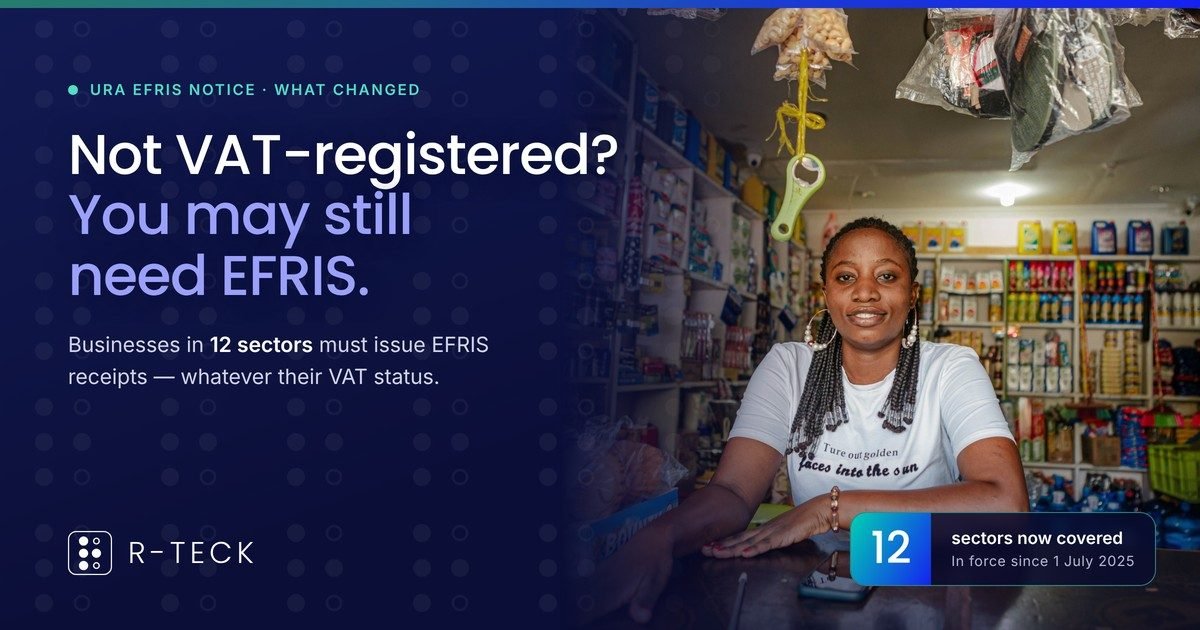
For years, most small business owners in Uganda treated EFRIS as somebody else's problem. If you weren't registered for VAT, URA's electronic invoicing system didn't apply to you.
That is no longer true for a large part of the economy.
On 10 August 2026, the Uganda Revenue Authority published a public notice titled "Additional Taxpayers Required to Use EFRIS". It confirms that businesses in twelve sectors must issue electronic invoices and receipts through EFRIS whether or not they are VAT-registered.
And the requirement is not new. The notice says it has applied since 1 July 2025.
What URA actually said
According to a tax alert from PKF Uganda, the August notice does not create a new rule. It clarifies an expansion made through a Uganda Gazette notice in July 2025, which extended the EFRIS requirement with effect from 1 July 2025. The 2026 notice is a reminder — and a sign that enforcement is coming.
This sits on top of the existing rule that every VAT-registered business must already use EFRIS.
The twelve sectors
If your business operates in any of these, read carefully:
- Manufacturing
- Mining and quarrying
- Water supply, sewerage, waste management and remediation
- Electricity, gas, steam and air-conditioning supply
- Construction — including repairs, renovations and extensions
- Transportation and storage — including cargo handling, storage and courier services
- Accommodation and food service — hotels, guesthouses, restaurants
- Information technology and communication
- Real estate — landlords, agents and brokers
- Professional, scientific and technical activities
- Arts, entertainment and recreation
- Wholesale and retail of fuel
That list covers a lot of ordinary businesses: the restaurant, the hardware fabricator, the small construction firm, the IT consultant, the event company, the landlord with a few units.
Who is exempt
The notice sets out four exclusions:
- Businesses in these sectors with annual turnover below UGX 10 million.
- Landlords with annual rental income below UGX 2.82 million.
- Passenger land transport — taxis, boda-bodas, shuttles and buses — at this phase of the rollout.
- Non-resident digital service providers who already pay Digital Service Tax.
UGX 10 million a year is under UGX 850,000 a month. Most businesses with a shop, a team or regular clients will be above it.
Exempt businesses can still choose to use EFRIS voluntarily — and some will want to, for the reason below.
The two details most people will miss
1. It is backdated
The notice was published in August 2026, but it states the obligation began in July 2025. If you are in one of these sectors and have been issuing ordinary receipts since then, you have a gap of more than a year. Talk to your accountant about what that means for you before URA raises it first.
2. Your customers now have a reason to demand EFRIS receipts
This is the part that changes behaviour. Under the Income Tax Act, a business cannot claim a tax deduction for an expense that isn't backed by an EFRIS invoice or receipt when the supplier was required to issue one.
In plain terms: if you supply another business and you don't issue an EFRIS receipt, your customer may lose the deduction on what they paid you. Expect corporate clients, NGOs and larger buyers to start asking for EFRIS receipts — and to move to suppliers who can provide them.
Business invoices and receipts must also carry the buyer's TIN, NIN or business registration number, so collect those details from business customers now.
What to do this week
- Check your sector and turnover. If you are in one of the twelve sectors and above UGX 10 million a year, the requirement applies to you.
- Register. Registration is free. Log in to the URA portal with your TIN, select EFRIS, and complete the onboarding.
- Choose how you will issue receipts. URA offers four routes:
- the web portal — fine for low volumes and good internet;
- the mobile app — built for small traders;
- system-to-system integration — your accounting or point-of-sale software sends each sale to EFRIS automatically;
- an Electronic Fiscal Device — a certified till that can issue receipts even offline.
- Clean up your product and service list. EFRIS needs every item named and categorised properly. If your stock list lives in a notebook, this is where the work is.
- Ask your accountant about July 2025 to now. Don't guess on the backdated period.
If you issue more than a handful of receipts a day, typing each one into the web portal will not last. That is when connecting your existing sales or stock system directly to EFRIS starts paying for itself. R-TECK can help you work out which route fits your volume.
A note on penalties
Penalties for not issuing EFRIS receipts are significant, and the law setting them was under revision in 2026. Rather than rely on a figure that may already have changed, confirm the current amounts with URA or your tax adviser.
This article explains a URA notice in plain language. It is not tax advice. For your specific position, speak to a qualified tax adviser or contact URA directly.
Over to you: Is your business in one of the twelve sectors — and are you issuing EFRIS receipts yet? Tell us in the comments below.
Know a business owner who still thinks EFRIS is only for VAT-registered companies? Share this with them.
Related

Why Ugandan Businesses Still Struggle With Digital Transformation — And How R-TECK Solves It
Paper records, manual calculations and WhatsApp orders still run most Ugandan shops, farms and factories. The problem is not ambition — it is systems built for a different environment. Why digital transformation keeps stalling here, and what it takes to fix it.

2026 Will Expose Weak Businesses — Is Yours Ready?
Many Ugandan businesses will struggle in 2026. Not because they lack money. Not because the market isn’t there. Because they are fragile, unstructured, and invisible to their own weaknesses. If your business can’t run without you, it isn’t a business — it’s a job you created for yourself.

Why Most Ugandan Businesses Are Always Busy — But Rarely Growing
Phones ringing, staff rushing, the owner everywhere at once — and six months later the business is no stronger. Busyness is not growth. Usually it is a sign that the business runs on its founder instead of on systems.
Comments (0)